- Found in 1897
- Exact charge
- Tiny mass
- Slow drift, fast signal
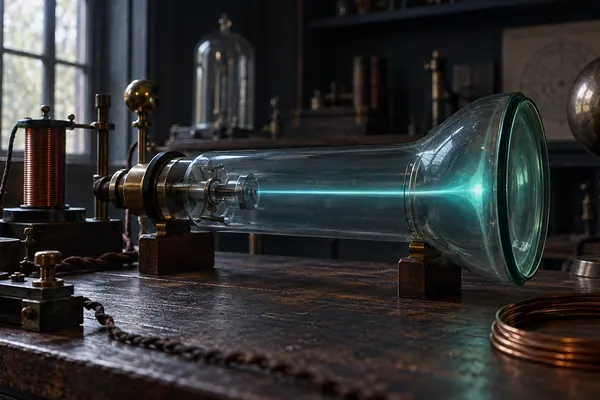
THE DISCOVERY
Rays that were particles
Thomson showed that cathode rays are streams of negatively charged particles, far lighter than any atom.
See what he measured doodletron
Updated
THE PARTICLE BEHIND ELECTRICITY
Every lamp, phone and kettle runs on a particle nobody knew existed until 1897.
J. J. Thomson found it in a glowing glass tube in Cambridge. Today its charge is fixed exactly, its mass is known to ten digits, and it still surprises people: in a wire, electrons barely move at all. Here is the story, in plain English.
Plain English, with the sources linked.
e⁻ found 1897
How fast do electrons go?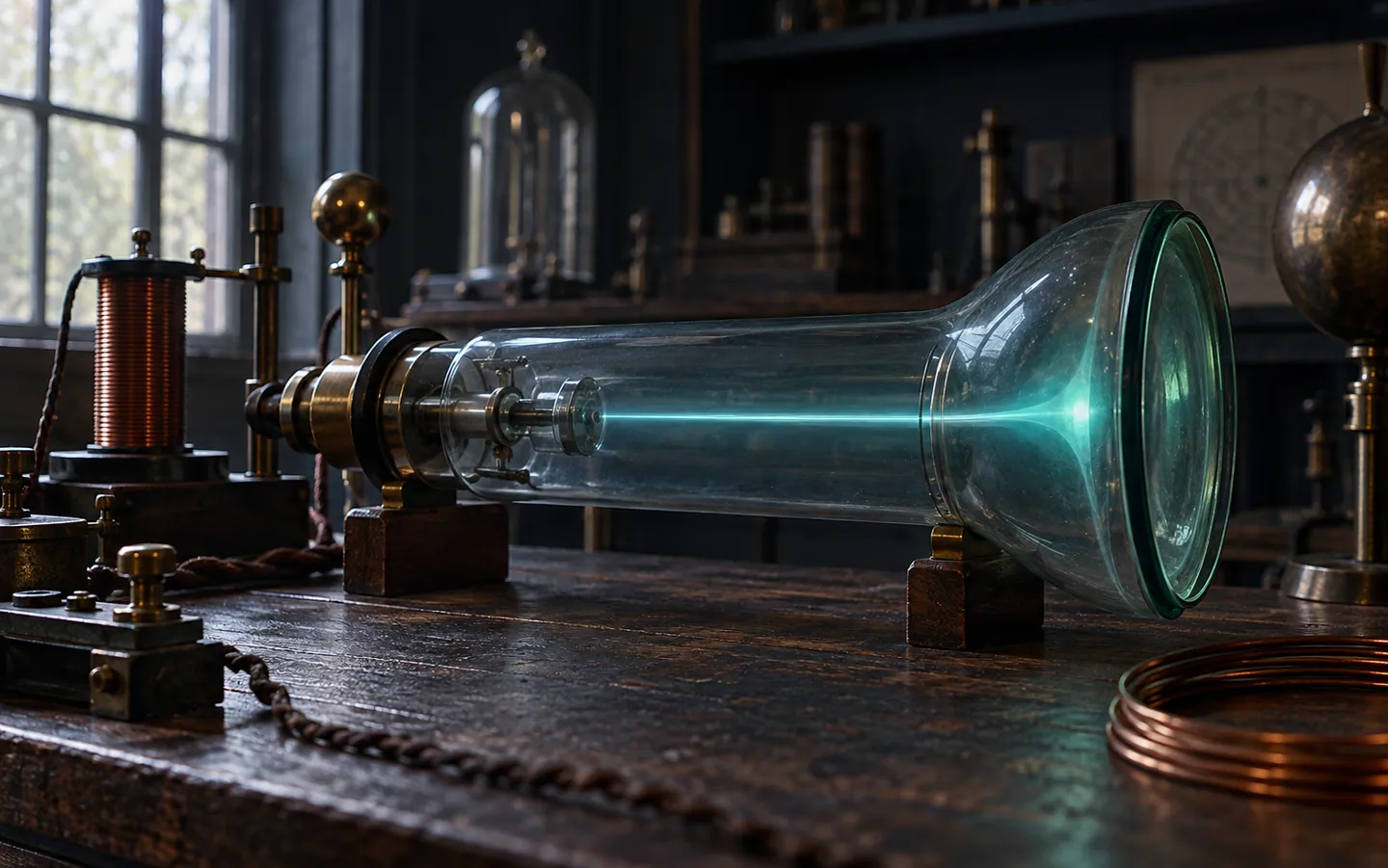
THE SHORT ANSWER
An electron is a negatively charged particle
that carries current through every wire.
THE DISCOVERY
Thomson showed that cathode rays are streams of negatively charged particles, far lighter than any atom.
See what he measuredTHE NUMBERS
Its charge is fixed exactly by definition; its mass is under a thousandth of a billionth of a billionth of a billionth of a kilogram.
The exact valuesIN A WIRE
Electrons in a wire drift at a snail’s pace, yet the signal travels at close to the speed of light.
Try the speed checkA QUICK SPEED CHECK
It depends on which speed you mean. Pick one to see the figure for an ordinary copper wire, using the worked example from Georgia State University’s HyperPhysics.
The figures are orders of magnitude for one example wire. Thicker wires and smaller currents give even slower drift.
THEN AND NOW
Thomson’s rough figure was the right size.
Modern measurement filled in the detail.
~1,000×
Lighter than a hydrogen atom by
Thomson judged his particle to weigh of the order of a thousand times less than a hydrogen atom, the lightest thing then known. It was enough to show cathode rays were something new, smaller than any atom.
CAMBRIDGE · 1897
1,836.15×
Lighter than a proton by
The internationally recommended values put the proton at 1,836.152673426 electron masses. Thomson’s order-of-magnitude estimate holds up: the electron really is nearly two thousand times lighter.
CODATA · 2022
Thomson won the 1906 Nobel Prize in Physics for his work on how electricity passes through gases, the research that revealed the electron.
SPOT IT AT HOME
A charger rated at 2 A moves roughly 12 billion billion electrons a second through its lead, each one only drifting slowly.
Circuit diagrams show current flowing from plus to minus. Electrons, being negative, actually drift the other way.
Bulky pre-flat-screen TVs and monitors were cathode-ray tubes: the same kind of glowing tube in which Thomson found the electron.
When a lamp comes on the moment you flick the switch, you are seeing the fast push, not fast electrons.


ELECTRON FACTS
Thomson first announced the electron at a Friday Evening Meeting of the Royal Institution on 30 April 1897. He led the Cavendish Laboratory in Cambridge from 1884 to 1918.
The elementary charge is exactly 1.602176634 × 10⁻¹⁹ coulombs. In today’s SI it is one of the constants used to define the units, so NIST lists it with no uncertainty.
The 2022 CODATA value for the electron’s mass is 9.1093837139 × 10⁻³¹ kg, with an uncertainty in only the last two digits.
One amp is one coulomb per second, which works out at about 6.24 × 10¹⁸ electrons passing a point every second.
CERN’s Large Electron-Positron Collider ran from 1989 to 2000 in a 27-kilometre ring, the largest electron-positron accelerator ever built. Its tunnel now houses the Large Hadron Collider.
QUICK QUESTIONS
Short answers to the questions people ask most.
Who discovered the electron?
J. J. Thomson, Cavendish Professor of Experimental Physics at Cambridge. He announced the particle at a Friday Evening Meeting of the Royal Institution in London on 30 April 1897, after experiments showing that cathode rays are streams of negatively charged particles.
How much charge does an electron carry?
Its charge is minus one elementary charge. The elementary charge is exactly 1.602176634 × 10⁻¹⁹ coulombs: in today’s SI this number is fixed by definition, so it has no measurement uncertainty.
How heavy is an electron?
The 2022 CODATA value is 9.1093837139 × 10⁻³¹ kilograms. A proton is about 1,836 times heavier, so almost all the mass of an atom sits in its nucleus.
If electrons move so slowly, why does a light come on instantly?
The wire is already full of electrons. Closing the switch sends a push along the whole wire at close to the speed of light, so electrons everywhere start drifting almost at once, even though each one only creeps along at millimetres per second or less.
How many electrons pass by in one amp?
One ampere is one coulomb per second. Dividing one coulomb by the elementary charge gives about 6.24 × 10¹⁸, so a current of one amp moves roughly six billion billion electrons past any point every second.
A NAME WITH SPARK
doodletron.com is part of the DoodleSale portfolio. It isn't in an auction right now, but you can ask about leasing it.